
What Is a Stablecoin?
What stablecoins are, how fiat-backed, crypto-backed and algorithmic stablecoins try to hold their value, what they’re used for and the risks to understand.

Hot wallets are convenient; cold wallets are safer. How each works, the real risks, costs and a simple rule for splitting your crypto between them.
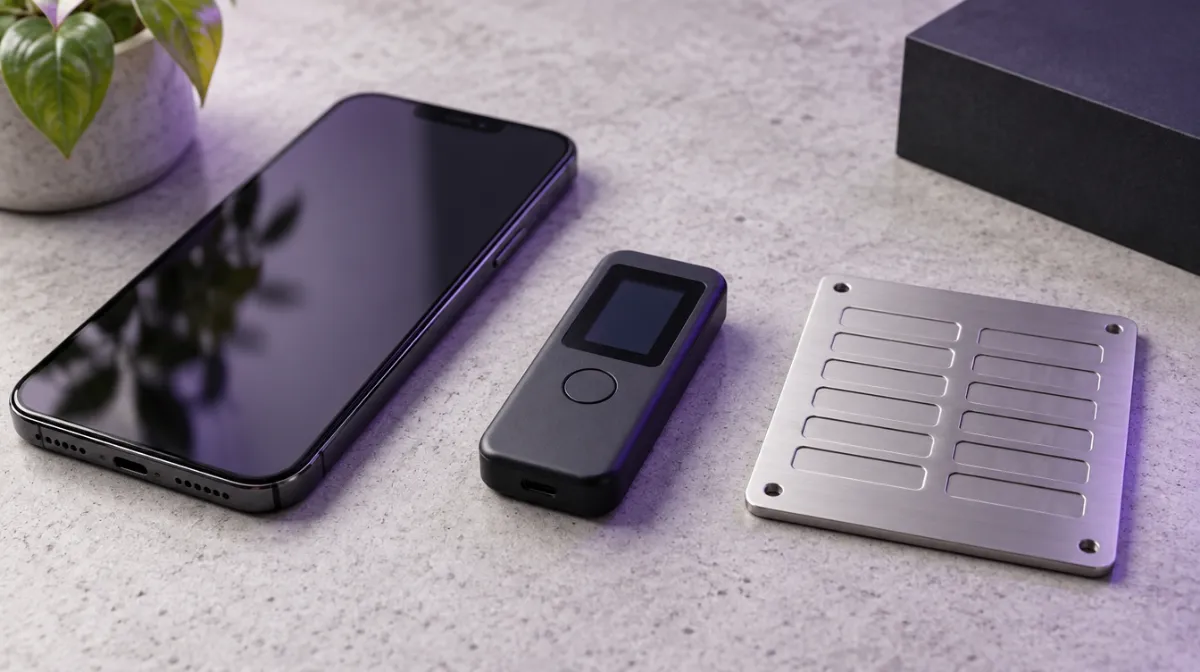
A crypto wallet doesn’t actually hold coins. Your coins live on a blockchain. What a wallet holds are your private keys: the secret codes that prove you own those coins and let you spend them. Whoever controls the keys controls the crypto. That’s why the choice between a hot wallet and a cold wallet is really a choice about how you protect your keys.
A hot wallet keeps your keys on a device that is connected to the internet: a phone app, a browser extension or desktop software.
Pros: free, quick to set up and easy to use for sending, receiving and trading. Cons: because it is online, it is exposed to malware, phishing sites, malicious browser extensions and phone theft.
A cold wallet keeps your keys offline. The most common type is a hardware wallet, a small device that stores keys and signs transactions internally, so the keys never touch your internet-connected computer. Other forms include paper wallets and fully offline computers, though these are harder to use safely.
Pros: much harder for remote attackers to reach; transactions must be physically approved on the device. Cons: costs money, takes more steps to use, and you are fully responsible for the device and backups.
| Hot wallet | Cold wallet | |
|---|---|---|
| Keys stored | On an internet-connected device | Offline |
| Cost | Usually free | Typically a one-off device purchase |
| Convenience | High | Lower |
| Main risks | Malware, phishing, stolen phone | Losing the device and backup, supply-chain tampering |
| Best for | Small amounts, frequent use | Long-term savings |
Leaving crypto on an exchange is different from both (exchange vs wallet explained). The exchange holds the keys (a custodial arrangement), so you are trusting the company. Exchanges can be hacked, freeze withdrawals or fail — as several large platforms have. The crypto saying “not your keys, not your coins” exists for this reason.
When you create a non-custodial wallet, hot or cold, you get a seed phrase, usually 12 or 24 words. It can recreate your wallet on any compatible device. Lose the device and you can recover with the phrase. Lose the phrase and the device, and your crypto is gone for good.
A simple, widely used approach:
If you hold only a small amount and are still learning, a reputable hot wallet with strong device security may be enough. As your holdings grow, cold storage becomes worth the cost and effort.
Remote attacks are very difficult because keys never leave the device. The bigger risks are tricking you into approving a malicious transaction, or someone obtaining your seed phrase.
Buy a new compatible device and restore your wallet using your seed phrase. Your crypto is on the blockchain, not in the device.
It can be, for small amounts, if you keep your phone updated, use strong device security, avoid unknown apps and links, and back up the seed phrase offline.

Every article is edited by a human and checked against our editorial policy. Spotted a mistake? Tell us.
What stablecoins are, how fiat-backed, crypto-backed and algorithmic stablecoins try to hold their value, what they’re used for and the risks to understand.
Ethereum explained in plain English: what makes it different from Bitcoin, how smart contracts and gas fees work, the switch to proof of stake and key risks.
What crypto staking is, how proof-of-stake validators earn rewards, the main ways to stake from solo validators to exchanges, and the risks behind the yields.